Case Study · Product & UX Design
Designing a Better Way to Host
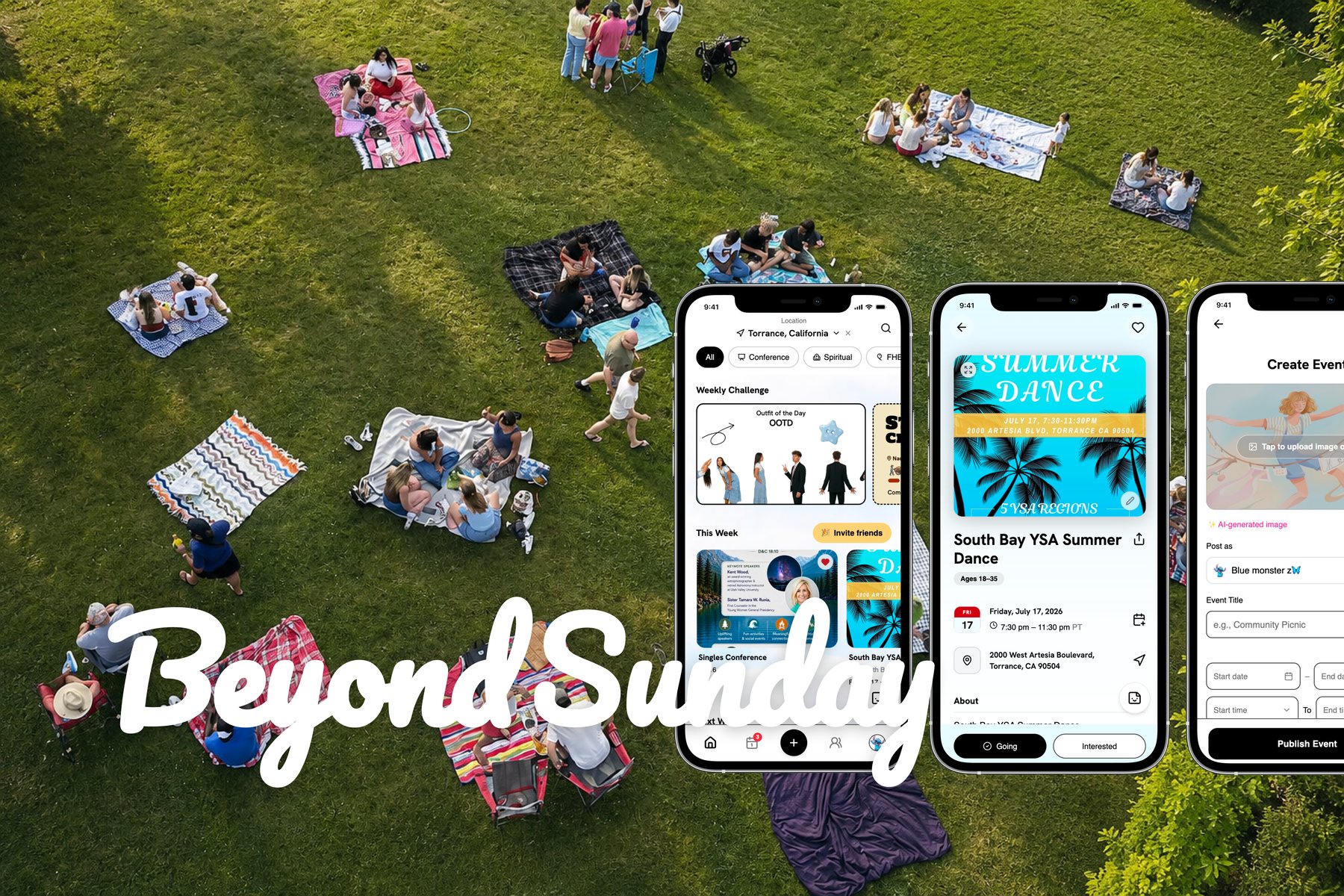
Beyond Sunday helps members discover activities, while giving volunteer organizers the tools to create, manage, and promote events without the usual chaos of group chats and scattered flyers.
The project began with a simple question: how can we create more opportunities for meaningful connection within the YSA community? As the project evolved, I realized the biggest challenge wasn't convincing people to attend events — it was making it easier for people to organize them.

I've been a member of The Church of Jesus Christ of Latter-day Saints for over ten years and have taken part in countless YSA activities, conferences, dances, and social events — many of which genuinely helped people build friendships, and some even led to marriage.
After moving to California, I noticed my local YSA community was much smaller than what I'd experienced before. Finding people in a similar stage of life became harder, which pushed me to think more carefully about how people discover opportunities to connect.
At first, I assumed the problem was simply helping people find more events. Attending more activities and talking with organizers showed me something more important.
The attendees weren't the bottleneck. The hosts were.
Through prototype testing, event attendance, and recurring conversations with volunteer organizers, one pattern kept surfacing: people generally wanted to attend activities. The real challenge was everything required to make those activities happen in the first place.
Originally, Beyond Sunday was meant to help people build stronger relationships directly. Research showed that meaningful relationships actually begin with meaningful opportunities to meet — and those opportunities depend entirely on someone willing to organize them.
Rather than trying to solve loneliness head-on, I shifted the product's focus to empowering the people who create those opportunities. If hosting becomes easier, more events happen. If more events happen, more people have a natural chance to connect. If I can help hosts succeed, everyone benefits.
Creating an event should feel simple, not overwhelming — even for a first-time host.
Hosting is rarely a one-person job. The platform should support collaboration and co-hosting by default.
Replace scattered Instagram posts, Facebook groups, and group chats with one reliable place for event information.
Designed as the central hub for each event: attendees can RSVP, add it to their calendar, share it, ask questions, and coordinate carpools — without leaving the page.
One unexpected technical challenge was getting the shared event preview image to render correctly across platforms like Facebook. Solving it noticeably improved how events looked when members shared them.
Most organizers already design a promotional flyer before publishing an event. Instead of asking them to re-type everything, an AI-powered workflow extracts the details straight from the uploaded flyer and fills in the form automatically.
Every page includes a feedback button, so suggestions come in while people are actually using the app. An admin dashboard tracks new registrations, event creation, and feedback — so the roadmap is driven by real behavior, not assumptions.